
Imagine you are downloading a top cryptocurrency wallet solution to make payments or process financial transactions.
However, the interface is clunky, the security features are outdated, and you can’t make sense of it in any way.
Would you like to use such a crypto wallet?
That’s why you need to identify some vital features that should be in your micro teaching.
We created this guide to separate the noise and emphasize the essential elements that any business should look for in a white-label cryptocurrency wallet. These features set enterprise-ready solutions apart from the competition, from unwavering security and smooth cross-platform access to DeFi, NFTs, and analytics. Continue reading because the wallet you select today may have an impact on your company tomorrow.
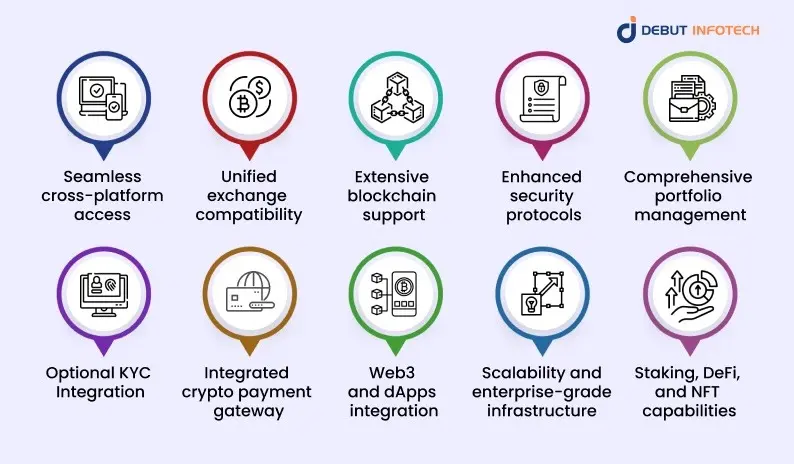
1. Seamless cross-platform access
What’s the point of a decentralized crypto wallet that only functions on certain devices? It almost defeats the point of using cryptocurrencies, right?
As an enterprise, it is important to know that nobody really has the time or even wants to juggle multiple devices in today’s busy business climate. Therefore, you need to ensure that any white label crypto wallet you’re using can function properly on both iOS, Android, and the web.
Customers want the same safe, user-friendly experience whether they are trading from a train, an office workstation, or a beach hammock. More so, having a wallet that works seamlessly across these platforms means your business has a better chance of delivering consistency in design and functionality.
All these perks are very important to the success of your business because cross-platform consistency is a competitive advantage that maintains user loyalty and engagement, in addition to being convenient.
2. Unified exchange compatibility
Still on the topic of unrestricted access, the best white-label crypto wallet for enterprises like yours must also be able to integrate seamlessly with leading centralized and decentralized exchanges, such as OKX, Binance, and Ethereum. This functionality is vital because most enterprises can’t afford fragmented experiences that require users to bounce from one platform to another just to exchange tokens.
Therefore, having that built-in exchange compatibility makes it easy for users to buy, sell, and swap tokens across multiple exchanges. And just like with seamless cross-platform access, this unified exchange compatibility not only increases user satisfaction but also creates new monetization opportunities through fees and partnerships.
So, before choosing that white label wallet solution, make sure you confirm if the platform allows you to manage, monitor, and trade your assets across multiple exchanges from a single, intuitive interface.
3. Extensive blockchain support
The number of blockchain ecosystems accessible through this wallet platform is another vital feature to consider before customizing it as your own. Effectively, this means verifying whether the crypto wallet solution is capable of harmonizing with major blockchains, such as Ethereum, BNB Chain, and Polygon.
This is very crucial to the success of your crypto wallet solution offering because users want options spanning altcoins, stablecoins, Layer 2s, and every other new and emerging crypto offering.
Therefore, enterprises should demand modular, easily extendable blockchain support so they can onboard new networks as the market evolves—without costly rebuilds. After all, innovation in crypto waits for no one. This robust compatibility empowers you to explore a diverse range of blockchain ecosystems with confidence.
4. Enhanced security protocols
Any white label wallet solution your enterprise will be adopting must be able to safeguard digital assets effectively and provide peace of mind. As such, enterprises should demand bank-grade security protocols such as the following:
- Multi-party computation (MPC)
- Biometric authentication
- Hardware wallet integration
- Real-time fraud detection
- 6-digit password protection
- Token balance concealment
- Instant app locking
- Secure recovery phrases
More importantly, it is crucial for these features to be integrated into the wallet’s core infrastructure from the ground up, rather than being added later. These enhanced protocols not only protect assets but also send a clear signal to enterprise clients and users: “Your funds are safe with us.” And that kind of trust (when established) can serve as a wonderful retention tool for enterprises of all sizes.
5. Comprehensive portfolio management
Enterprises must also make sure that their chosen white label wallet solution is robust enough to help users manage their entire crypto portfolio, all from one user-friendly dashboard. This means the crypto wallet must be able to double as a portfolio manager that can track balances, performances, transaction history, and even tax-friendly reports.
Clearly, these portfolio management features make it easy for the final users to manage their crypto holdings, but they also benefit enterprises in the process because the features boost stickiness, upsell services, and create differentiated value.
So, you must be able to guess the different ways in which these new developments can empower your enterprise customers to make smarter decisions. Once you do that, you have a competitive edge over most other competitors.
6. Optional KYC Integration
Offering an added layer of trust when processing transactions is fast becoming a standard practice when offering crypto wallet services. Nonetheless, it is not all-binding: while some individuals love the idea of being free and anonymous, regulators, on the other hand, are seeking new ways to ensure that all users provide some form of identification before they can use these online services. That is why businesses need the ability to turn KYC (Know Your Customer) on or off based on use cases and compliance requirements.
By integrating optional KYC, businesses can accommodate both worlds. Think of it as a VIP lounge where businesses can open the gates for more stringent onboarding when necessary or relax them for communities that thrive on transparency. By incorporating KYC optionality into the wallet, businesses remain agile, meeting international compliance regulations without offending user bases that prioritize speed and privacy.
7. Integrated crypto payment gateway
An integrated crypto payment gateway is an online system that facilitates the use of cryptocurrencies for the payment of a business’s products or services. As more businesses begin to see the potential in cryptocurrencies, we are witnessing a corresponding increase in the use of integrated crypto payment gateways by various companies.
Therefore, it is simply backward to launch a crypto wallet solution that lacks these modern, futuristic features. On the brighter side, as soon as you start putting the word out there that your enterprise white label crypto wallet allows customers to pay for services, subscriptions, or products directly with crypto, you’re already getting an edge over your competition.
8. Web3 and dApps integration
Today, crypto owners are not just holding or making purchases with cryptocurrencies. Rather, they are also playing, staking, farming, and exploring Web3 realms.
Wondering how they are able to facilitate these activities?
You guessed right! Crypto wallet solutions provide direct access to these decentralized apps (dApps)
Consider it a Web3 browser that lets consumers interact with DeFi platforms, NFT marketplaces, and metaverse applications without ever leaving the environment of your business. This functionality places your business at the center of the decentralized revolution in addition to future-proofing your wallet. Businesses that integrate dApps present themselves as leaders rather than followers. Nobody wants to miss the next big Web3 wave, after all.
9. Scalability and enterprise-grade infrastructure
You should demand advanced features and settings that make it easy to support the thousands (or millions) of users that your crypto wallet will support as the company grows in awareness and finances.
This is very crucial because the entire wallet platform may crumble due to a slight increase in pressure or usage.
Therefore, you should demand advanced scalability and support features like cloud-native architectures, load balancing, and high-throughput systems that scale gracefully as demand spikes. Think of it like building a highway: better to design for heavy traffic now than deal with gridlock later. Enterprise-grade infrastructure also includes uptime guarantees, SLAs, and APIs that plug into existing systems. A scalable wallet isn’t just a tool—it’s a long-term growth enabler.
10. Staking, DeFi, and NFT capabilities
Crypto wallets are fast becoming playgrounds for opportunities, rather than merely being a place to store money. As a result, businesses that provide staking, DeFi, and NFT capabilities enable users to explore decentralized finance, build wealth, and interact with digital culture without ever leaving their wallets.
Consider clients who not only own assets but also participate in liquidity pools, bid on digital artwork, or earn yield on their investments. By integrating these functionalities, organizations tap into sticky, high-engagement use cases. It’s not just about keeping pace with the industry—it’s about becoming the center where people discover the future of banking. Consider the “Swiss Army knife” of the blockchain era.
Conclusion
That’s right! A white label crypto wallet is more than just a location to save digital assets; it is the foundation of your company’s future.
The elements we have examined, which range from Web3 connectors and analytics to security and scalability, are not “nice-to-haves”; rather, they are necessary for gaining the trust of clients and remaining competitive.
The good news?
It’s not necessary for you to put everything together by yourself. Businesses may get end-to-end crypto wallet development services that offer every feature customized for their business by working with an experienced partner like Debut Infotech. Because the greatest wallets for cryptocurrency do more than just store assets, they also open doors, and that’s what you need this period.
Also Read-Can Demo Mode Save Me Money?