
As the global economy pivots towards net zero, the scrutiny on corporate carbon footprints has intensifies. Businesses are accustomed to auditing their supply chains, energy consumption, and manufacturing processes. However, one area often overlooks is the environmental cost of digital content production and marketing.
Traditional video production is resource-intensive. It requires travel, logistics, equipment transport, and significant energy consumption. In this context, the rapid emergence of Artificial Intelligence offering text to video capabilities presents more than just a novelty; it offers a pathway to sustainable digital transformation.
By allowing creators to generate high-fidelity visuals from simple scripts, text to video AI converts words into motion without the need for cameras, crews, or intercontinental flights. For the green business sector, this technology is a powerful tool for communication, education, and advocacy. Here is an in-depth look at what you can do with text to video technology to drive efficiency and sustainability.
The Intersection of Digital Innovation and Sustainability
The premise of text to video technology is straightforward yet revolutionary. A user inputs a descriptive text prompt—ranging from a single sentence to a detailed paragraph—and the AI generates a coherent video clip. This process is powered by deep learning models trained on vast datasets of video and text pairs.
For the eco-conscious enterprise, the appeal is twofold: cost efficiency and carbon reduction. A traditional on-location shoot for a renewable energy firm might involve flying a crew to an offshore wind farm, utilising helicopters for aerial shots, and catering for a large team. The carbon emissions associated with such logistics are substantial.
Conversely, an advanced AI text to video tool can generate photorealistic footage of wind turbines, simulated weather patterns, or solar array operations entirely within a server environment. While data centres do consume energy, the comparative carbon footprint is significantly lower than physical production chains. This shift represents a crucial step in “dematerialising” the marketing supply chain.
By leveraging text to video solutions, companies can maintain a high volume of engaging content while adhering to strict ESG (Environmental, Social, and Governance) criteria. It is a prime example of how digital tools can facilitate the transition to a greener economy.
5 Revolutionary Use Cases for Text to Video in the Green Economy
To truly understand the value of this technology, we must look beyond general applications and examine how it solves specific problems within the sustainability sector. Here are five strategic ways stakeholders can utilise text to video tools.
Green Marketing: Reducing Scope 3 Emissions in Campaigns
Marketing and advertising are essential for the adoption of green consumerism, yet the production of these materials often contradicts the message of conservation. High-gloss commercials typically require extensive travel and resource usage, contributing to a company’s Scope 3 emissions.
Text to video technology fundamentally alters this dynamic. Marketing teams can now create AI videos from text prompts to produce high-quality assets without leaving the office.
● Scenario: An eco-tourism company wants to promote a sanctuary in Costa Rica. Instead of sending a film crew from London—generating tonnes of CO2 via air travel—the marketing team can use a text to video platform. By inputting prompts such as “Cinematic drone shot of a lush rainforest in Costa Rica, morning mist, vibrant biodiversity,” the AI generates suitable B-roll footage.
● The Advantage: This allows for rapid A/B testing of marketing messages without the financial or environmental cost of reshoots. If the campaign narrative changes, the video can be regenerated in minutes rather than weeks.
Furthermore, integrating text to video workflows allows brands to scale their content output. A company selling biodegradable packaging can produce hundreds of unique product variants and usage scenarios using AI, ensuring that their visual marketing is as sustainable as the product they are selling.
Sustainable Design: Visualising Future Infrastructure
One of the greatest challenges in the architecture, engineering, and construction (AEC) industry is conveying the vision of a project before the first brick is laid. This is particularly true for green buildings and sustainable urban planning, where concepts often involve novel technologies or non-traditional aesthetics.
Designers and urban planners can utilise text to video software to bridge the gap between technical blueprints and public understanding.
● Scenario: An urban planning firm is pitching a concept for a “15-minute city” with integrated vertical farming. Static renderings are often insufficient to convey the feel of the space. Using an AI text to video tool, the planners can input descriptions of the environment: “A bustling pedestrian street with solar-glass buildings, vertical gardens on facades, and electric trams passing by.”
● The Advantage: The resulting video provides stakeholders—including investors and local councils—with a dynamic, immersive preview of the sustainable infrastructure. This visualisation capability aids in securing funding and community approval by making the abstract concept of “green living” tangible.
The speed of text to video generation also means that architects can iterate designs in real-time during client meetings. If a client asks, “What would this look like with a timber facade instead of glass?”, the prompt can be adjusted, and a new video visualisation generated, streamlining the design process and reducing wasted resources on rejected prototypes.

Education: Simplifying Complex CleanTech Concepts
The transition to renewable energy involves complex technologies that the general public, and even some investors, may find difficult to grasp. Concepts like Green Hydrogen production, Carbon Capture and Storage (CCS), or the circular economy supply chain are often buried in dense technical white papers.
Education is a prime vertical for text to video application. By converting technical text into visual explainers, companies can democratise knowledge about clean technology.
● Scenario: A CleanTech startup has developed a new method for battery recycling. To explain the chemical process to potential investors who lack a science background, they use a text to video generator. They input the script of their technical documentation, instructing the AI to “Show an animation of lithium-ion battery components being separated and purified in a closed-loop system.”
● The Advantage: The AI breaks down the text into visual sequences, creating an educational video that simplifies the complex science. This is far more effective than a PowerPoint presentation.
Educational institutions and environmental NGOs can also leverage text to video to create curriculum materials. Teachers can create AI videos from text to show historical climate data or projections of future environmental scenarios, making climate literacy more engaging for students. The ability to localise these videos into different languages simply by translating the text prompt ensures global accessibility for environmental education.
Storytelling: Visualising the Impact for NGOs
Non-Governmental Organisations (NGOs) and charities operating in the environmental sector often face a “storytelling gap.” They deal with critical issues like deforestation, ocean plastic, or melting ice caps, but often lack the budget to produce Hollywood-level documentaries to raise awareness.
Text to video democratises high-end visual storytelling. It allows smaller organisations to punch above their weight, creating emotional and compelling narratives that drive donor engagement.
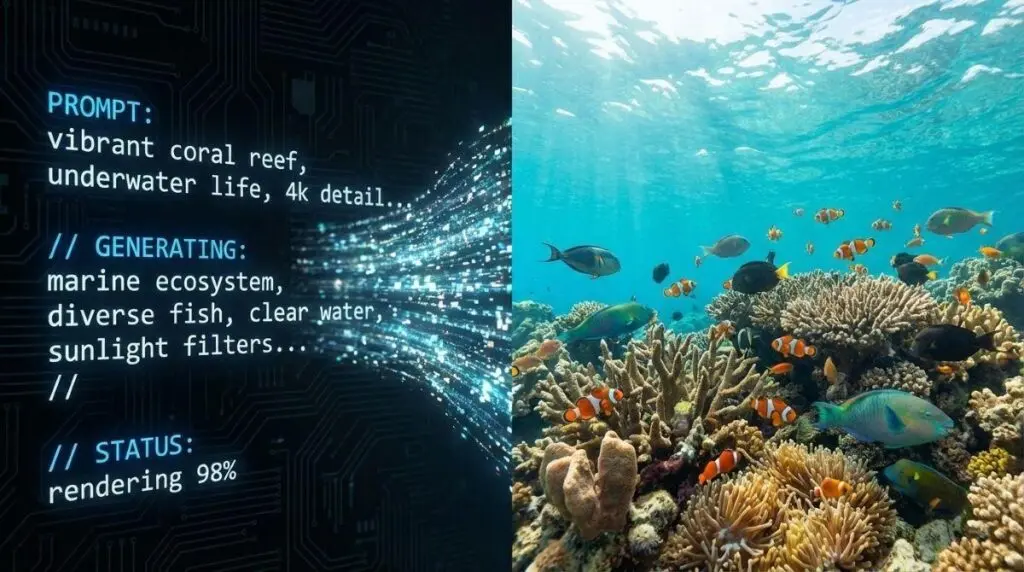
● Scenario: An ocean conservation charity wants to launch a campaign about the future of coral reefs if temperatures rise by 2°C. Filming a “future scenario” is impossible, and CGI (Computer Generated Imagery) is prohibitively expensive. Instead, they turn to text to video AI. They craft a narrative prompt describing the degradation of the reef over decades.
● The Advantage: The AI generates a visceral, time-lapse style video showing the bleaching event. This visual storytelling creates an emotional urgency that text alone cannot convey.
By using text to video, NGOs can also visualise success stories. They can generate videos depicting “reforested landscapes in 2050” based on current planting data, giving donors a hopeful vision of what their contributions are achieving. This capability aligns perfectly with the need for transparent and motivating communication in the non-profit sector.
Social Media: Rapid Response Advocacy
In the fast-paced world of social media, environmental advocacy requires speed. When a climate summit is happening, or an environmental policy is announced, organisations need to react instantly to shape the narrative. Traditional video production is too slow for the news cycle.
Text to video tools act as a force multiplier for social media managers in the green sector.
● Scenario: A major report on biodiversity loss is released. An environmental advocacy group wants to highlight key findings on Instagram and LinkedIn. Rather than spending days editing footage, the social media manager highlights key stats in the report and feeds them into a text to video platform.
● The Advantage: Within minutes, the tool produces a short, captioned video formatted for mobile screens, visualising the data points. This allows the organisation to lead the conversation while the topic is trending.
Furthermore, social platforms favour video content over text and static images. By converting blog posts, press releases, and policy briefs into short video clips using text to video technology, green businesses can significantly increase their organic reach and engagement rates. It ensures that vital environmental messages are not lost in the algorithm but are presented in the format that modern audiences consume most.
Final Thoughts: The Future of Green Digital Media
The adoption of text to video technology is not merely a trend; it is part of a broader shift towards efficiency in the digital age. For the UK’s green business sector, which prides itself on innovation and responsibility, adopting these tools is a logical step.
However, it is important to approach this technology with a balanced perspective. Text to video is an enhancer of human creativity, not a total replacement. The “Human in the Loop” remains essential to ensure the accuracy of scientific data and the ethical framing of environmental narratives. The AI provides the visualisation, but the sustainability professional provides the vision.
As text to video models continue to evolve, becoming more energy-efficient and producing higher resolution outputs, they will become standard practice in corporate communications. We are moving towards a future where a sustainability report is not just a PDF, but an interactive video experience generated instantly from data.
For business leaders, marketers, and environmentalists, the question is no longer if you should use AI content generation, but how you can use it to amplify your message while minimising your footprint. Whether it is visualising a net-zero future, explaining complex clean tech, or reducing the travel miles of your marketing department, text to video offers a versatile solution.
Incorporating an AI text to video tool into your workflow is more than a productivity hack; it is a commitment to a smarter, leaner, and more visually impactful way of doing business. As we strive to build a sustainable world, the tools we use to tell our stories must be as sustainable as the future we hope to create.